Roundhouses

I recently heard from owner-builder Marvin McConoughey of Corvalis, Oregon, who with his wife built their own house in the 1980s. I was impressed by their ambition (the house is about 2,500 sf), and by their dedication (it took six years). My wife and I spent three years building our own house—which I thought was seriously pushing the limits of both our sanity and our conjugal well-being.

Oh, and the McConoughey house is circular in plan! What is it about round houses that fascinates people? Inigo Jones designed several octagonal houses (although as far as we know he did not build any) and Jefferson built a famous octagonal house at Poplar Forest.
Read more

Castle is Home

P1000698

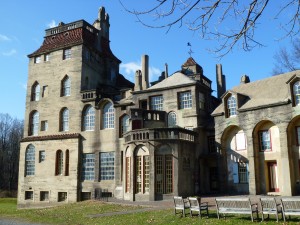
Fonthill Castle, in Doylestown, Pennsylvania, is rarely included among the great country houses of the Gilded Age. This extraordinary house is not designed by an architect, it does not follow one of the accepted styles of the period, and it is just, well, too weird. I can’t think of an American country house that looks like a fortified manor house, not even San Simeon—the closest is Sir Edwin Lutyens’s Castle Drogo in Devon. Fonthill was designed and built between 1908 and 1912 by Henry Chapman Mercer. Like many country-house builders,

Read more

LEED Lies


Why are so many LEED-certified buildings all-glass? It seemed to defy logic. After all, no matter how much you can reduce artificial lighting by using daylight, the insulation value of glass is negligible compared to solid insulated walls, and anyway there are many overcast days and dark winter afternoons. It is even  more puzzling when an all-glass building is shaded. First you wrap it in glass, and then you wrap the glass in something else. I always suspected that this was more about announcing “I am a green building” than about actually conserving energy. And now it’s official.

Read more

Modernism the Good

I’ve been reading David Watkin’s Morality and Architecture and I’m struck by the parallel that he draws between modernism and totalitarianism. Now, the conventional story, told and re-told by advocates of the International Style, was that modernist architecture was a moral force, not only opposed to (bad) nineteenth-century Beaux Arts architecture, but also to Nazism and Fascism. This claim was lent credence by the fact that so many leading modernists—Walter Gropius, Mies van der Rohe, Eric Mendelsohn, Marcel Breuer—had fled Nazi Germany. That Le Corbusier happily offered his services to the rightist Vichy regime in France,

Read more

Cinematic Spaces

Last week I re-watched Roman Polanski’s 1966 film Cul-de-Sac. Lionel Stander and Donald Pleasance are first-rate, but they share star billing with Lindisfarne Castle, which is the location of this one-setting film. Lindisfarne is a sixteenth-century castle that was restored and converted into a country retreat by Sir Edwin Lutyens, whose austere architecture contributes greatly to the tense atmosphere of the film. It reminded me how few movie director’s have exploited outstanding architecture. Joseph Losey set his version of Mozart’s Don Giovanni (1979) in and around Vicenza, and made full use of Palladio’s Villa Rotonda.

Read more

Kahn’t Do It

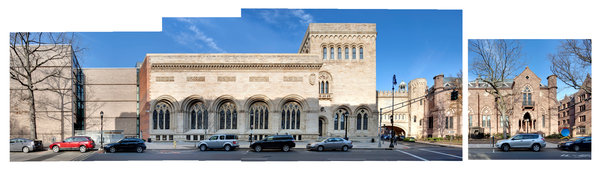
A photograph by New York Times photographer Bruce Buck accompanies an article on the wonderful renovation of the Yale University Art Gallery. The gallery was built in three stages: a tall 1866 Ruskinian Gothic first phase by Peter Bonnett Wight (right); a 1928 Florentine Gothic horizontal portion by Egerton Swartwout; and a 1953 addition by Louis Kahn. What Buck’s photo clearly shows is the insensitivity of Kahn’s addition. It is not a question of style—Swartwout did not follow Wight’s lead either—but of massing. The Swartwout wing was rudely truncated by a brick party wall,

Read more

Simply Ike

The final review of Frank Gehry’s design for the Eisenhower Memorial in Washington, D.C., has been postponed yet again and the project seems more and more likely to be shelved. In a recent letter to Sen. Daniel Inouye, John S. D. Eisenhower, the President’s son, raises an issue that has nothing to do with the quality of Gehry’s design (which I have supported), nor with the over-wrought classical-modernist debate. Why couldn’t the memorial simply be “a green open space with a statue in the middle” he asks? Good question. Ever since the FDR Memorial spread over more than seven acres,

Read more