INVISIBLE DECOR

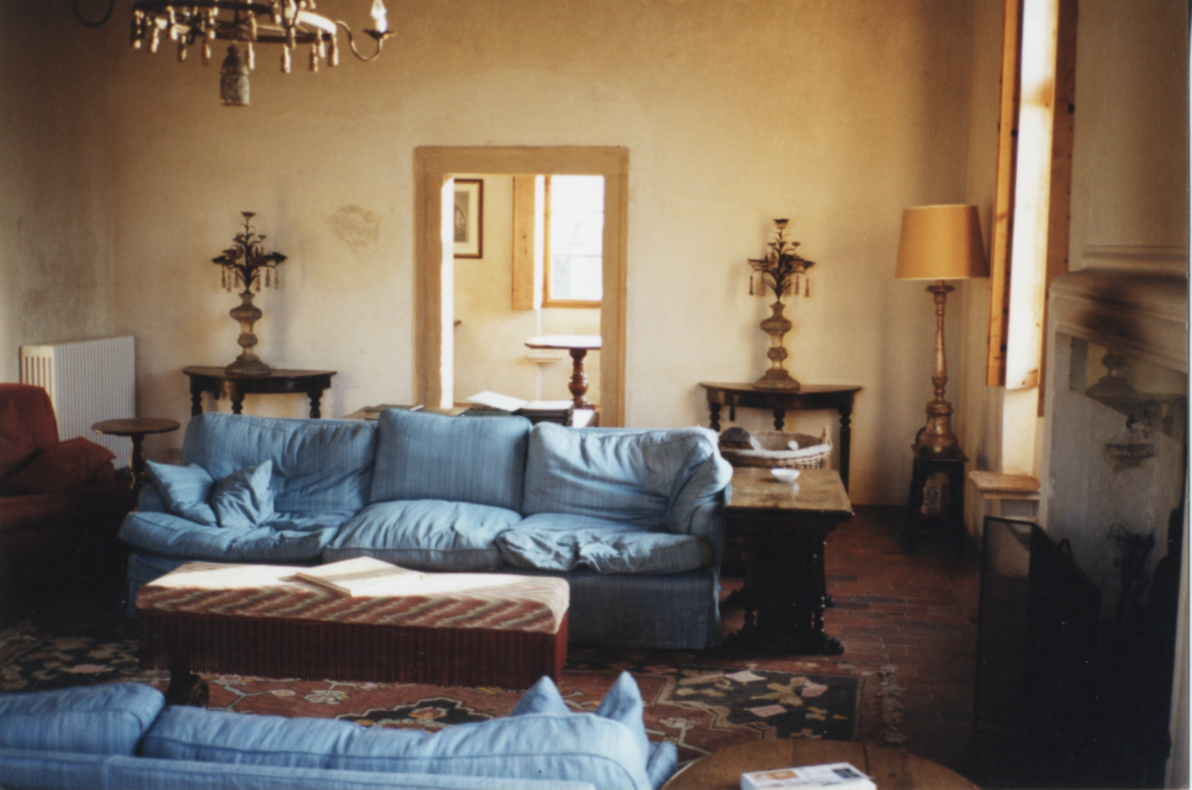
Years ago I had an unexpected satori. It occurred in the beachside clubhouse of Windsor, an upscale resort community in Florida. It was a most pleasant room, relaxed, quietly comfortable, a place to relax. I learned later that it was the work of the grande dame of New York decorators (whose name I now can’t recall). Aha, I thought, now I understand—great interior decoration is invisible. It reminded me of something that my friend Marc Appleton said, “I’ve always admired Billy Wilder’s direction because you’re not aware of it, only the story he’s telling.” Describing his own house Marc told me “I hope it doesn’t look like an architect had anything to do with it.” Another satori occurred when Shirley and I spent a week in Andrea Palladio’s Villa Saraceno (see the living room above).
Read more

STARCHITECTS

I’ve recently come across several articles on the demise of the starchitect. While this may or may not be true, what strikes me is the general misunderstanding of the starchitect phenomenon. It is not a plot to promote certain architects. It is not a media invention. It is not a system. It is not merely a reflection of celebrity culture. The term ”star” derives from Hollywood. The movie star is an actor or actress who achieves exceptional public name recognition. This is ultimately an economic measure because it means that, all things being equal, the participation of a star in a proposed movie can make it bankable.

Read more

THE OLD RULES

The Louis Kahn/I. M. Pei generation of architects were modernists who had dispensed with many of the previously essential aspects of architecture such as ornament, but they still believed in buildings ordered by rules, especially the old rules of geometry, symmetry, centering, axes, and so on. That didn’t mean that they didn’t diverge from those rules—in Pei’s case quite often—but when they they did so they were always aware of the break and compensated in some way. That seems to be what is missing in current architecture. There are no rules, broken or unbroken, which too often results in mere confusion.

Read more

LÉON KRIER, ARCHITECT AND TOWN PLANNER (1946-2025)

Léon Krier was a character. He dressed like an impresario, wrote like a pamphleteer, and drew like an angel. He happily stoked public controversy. His most famous bon mot was “I’m an architect, because I don’t build.” But he did build. The three buildings that I’ve seen of his—his own house, a town hall, and a university audiitorium—have a quality that seems to have eluded most of his traditional-minded contemporaries: originality. He was a classicist, but not a revivalist. He was original, too, in his thinking about town planning, to use an old-fashioned term he would have liked. To Krier,

Read more

CHARM AND GRANITE

I was saddened to learn of the death of David Childs (1941-2025). He was the chair when I joined the Commission of Fine Arts, and an intelligent architect and a charming man. Reading the obituaries put me in mind of something I came across while writing The Biography of a Building, about the Sainsbury Centre for the Visual Arts, a very early Norman Foster design. Sir Hugh Casson, the dean of postwar British architects, had written a letter of recommendation for the young Foster, who was being considered for the job: “As you have already met him [Foster],

Read more

FUSION ON THE MAIN LINE

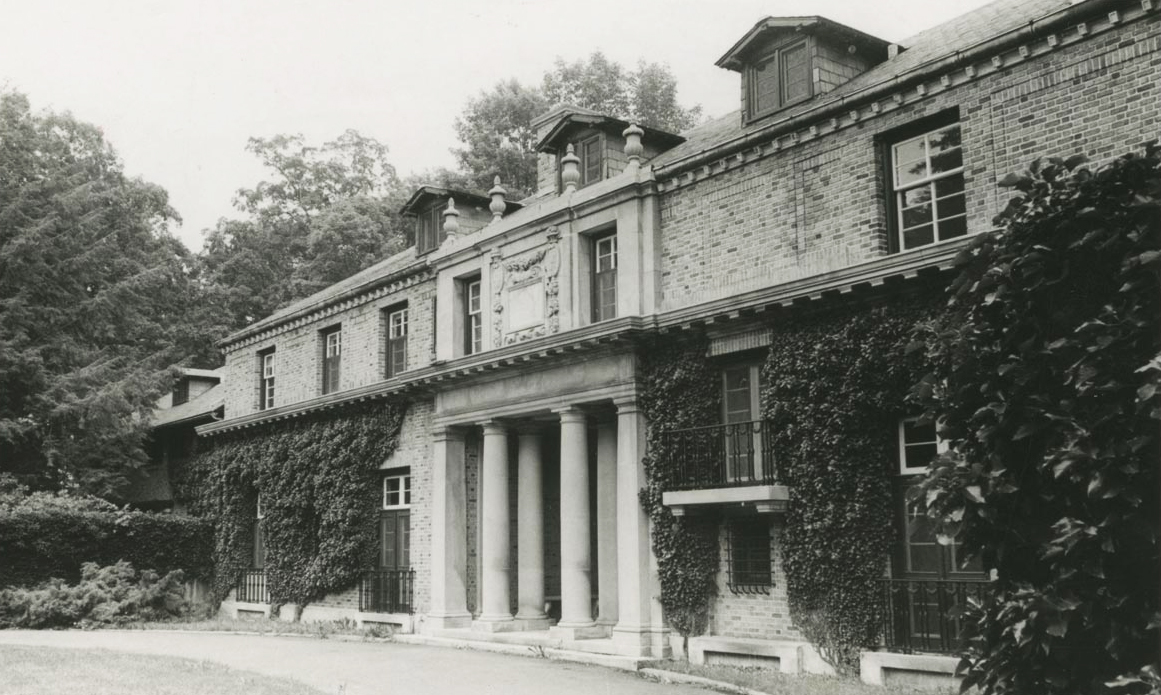
The other day I had the opportunity to visit Camp-Woods, a house on Philadelphia’s Main Line. It was built in 1910-12 for James M. Willcox, a banker who would later be president of the Philadelphia Saving Fund Society—and would commission the PSFS Building, America’s first International Style skyscraper. Camp-Woods is definitely not International Style, according to the brief Wiki entry it is Italianate-Georgian. While the architecture is a fusion, that is a misleading description. The architect was Howard Van Doren Shaw (1869-1926), one of the leading residential architects of his day—he was awarded the AIA Gold Medal, a high honor at that time.

Read more

A HUNGARIAN ARCHITECT IN AMERICA

I watched The Brutalist yesterday. My reaction? An implausible story poorly told and awkwardly stitched together; the Holocaust connection seemed gratuitous; a ham-handedly written script, the audience actually snickered at some of more pompous utterances of the Guy Pearce character; distracting bursts of portentous music at odd moments; and glitches, like Tóth saying square meters when he knows his audience understands only square feet, or producing the kind of expressionistic sketches that are out of character for a Bauhaus-trained architect—more like something the great Eric Mendelsohn would draw. As for the title, while Tóth was definitely brutalized, it made no sense to me,

Read more

RADOSLAV ZUK (1931-2024)

Rad Zuk was a longtime colleague of mine when I taught at McGill for two decades, but my first encounter with him was when I was a student there in the 1960s. I was in the penultimate year of a six-year course. Zuk had joined the faculty a year or two earlier, and I had not had him as a teacher, but somehow I ended up briefly working for him. I can’t remember if he approached me, or if I saw a want ad on the school bulletin board. The job was to draw up a project he was working on—a church.

Read more