
BRITISH CLASSICISM
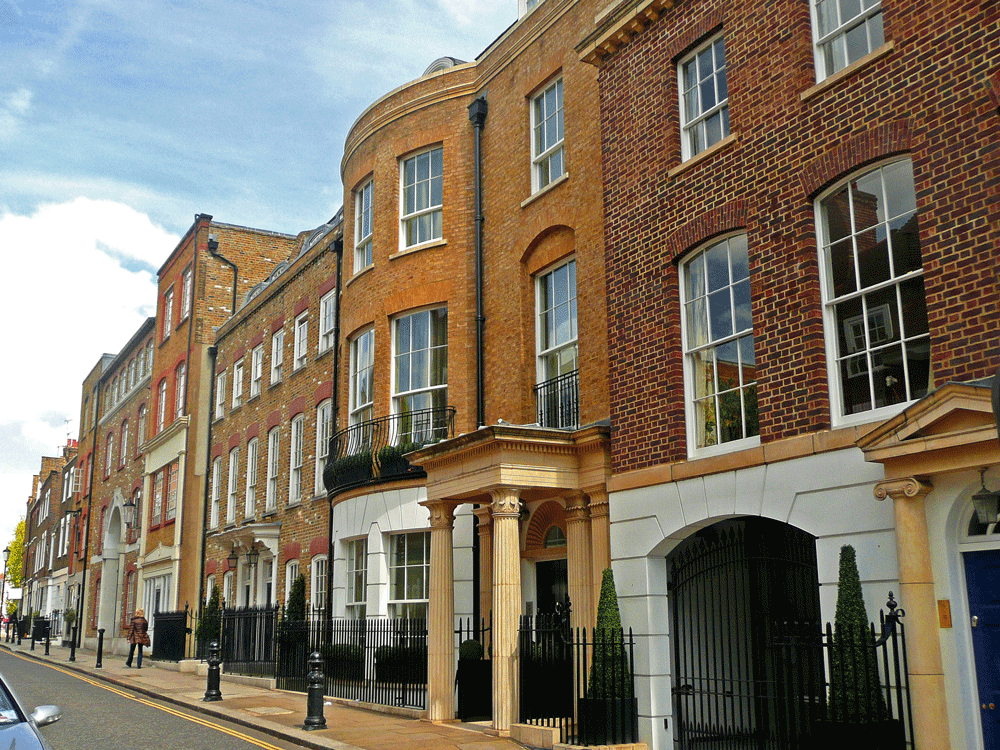
Reading a recent monograph on the work of John Simpson, I am struck again by the difference between American and British classicism. For one thing, the former is rooted in a much shorter tradition. Moreover, it is a tradition that is, in a sense, academic. Or, at least bookish. In the first instance it derived from (British) pattern books, which were the main source of information for the early colonial builders. Nineteenth-century American classicism, on the other hand, was chiefly the product of the Ecole des Beaux-Arts, where many American architects of that period were trained. Although there were many talented self-taught architects such as Stanford White, Ralph Adams Cram, Bertram Goodhue, and Horace Trumbauer, the leading figures—Richard Morris Hunt, Charles McKim, John Russell Pope, and Thomas Hastings—were EBA alumni, and brought a correct and sometimes rather dry approach to classicism. This is in contrast to nineteenth-century British classicism, which was not based in the academy but in practice. The influence of architects such as John Nash, John Soane, and C. R. Cockerell is evident in Simpson’s designs which are more self-assuredly original than those of many of his American contemporaries which can be often more concerned with correctness than with invention.
PARKWAY OR BOULEVARD?
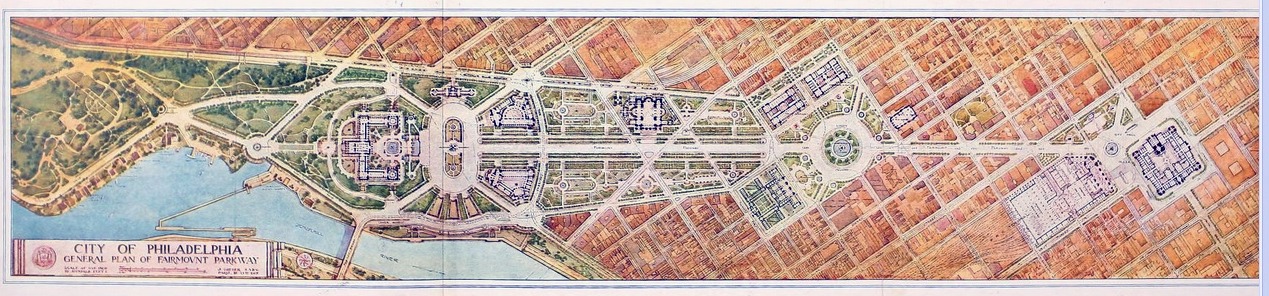
Last year was the centenary of the design of the Benjamin Franklin Parkway in Philadelphia. Designed by the Parisian landscape architect, Jacques Gréber in 1917, the avenue slashed diagonally across William Penn’s grid, connecting Logan Circle to Fairmount, a hill which would be the site of the Philadelphia Museum of Art. Gréber was a notable figure. He worked with Horace Trumbauer (the architect of the future museum) on several mansions, including the Versailles-like Whitemarsh Hall, and collaborated with Paul Cret on the Rodin Museum. (Trumbauer and Cret first proposed the idea of a parkway.) Gréber, who was the chief planner of the 1937 Paris International Exposition, was also responsible for laying out scenic drives in Ottawa.
The Benjamin Franklin Parkway (originally the Fairmount Parkway) is said to have been based on the Avenue des Champs-Elysées, but that is misleading. This is a parkway on the Olmstedian model. The highlight of Gréber’s Ottawa plan is a drive along the Ottawa River, not so different from Philadelphia’s Kelly Drive (named after Jack Kelly, a gold medal Olympic rower and the brother of the famous actress) that wends its way beside the Schuylkill River through Fairmount Park.
VINCENT SCULLY, 1920-2017
 I never attended any of Vincent Scully’s legendary Yale architecture classes but I did hear him speak several times in Montreal, part of the Alcan lecture series that Peter Rose organized in the 1970s. So I could understand when people spoke of his influence. Scully introduced a Celtic passion to the sometimes dry subject of architectural history and his lectures were bravura performances that brought old buildings—and their builders—to life. He was an activist historian in the mold of Siegfried Giedion, and he influenced the contemporary scene, being an early advocate of the work of Louis Kahn and Robert Venturi. I wonder if his obituaries will recall that he made a major volte-face late in life, becoming a critic of mid-century modernism’s negative impact on the city (especially his city, New Haven) and a proponent of New Urbanism. Humanism was at the core of his architectural beliefs.
THE DARK SIDE
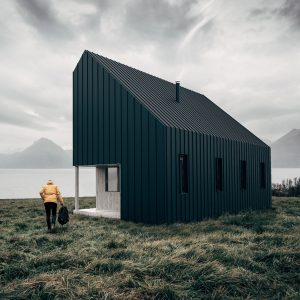 What’s with all the black houses that have appeared in recent years? The all-black exteriors—blackened timber, black stain, or simple black paint—have become ubiquitous. Rural or urban, even old buildings are getting black-faced. Traditionally, architects avoided black facades, which not only look lugubrious but virtually eliminate shadows, which are—or were—one of the architect’s most effective tools. Modern houses tend not to have moldings and relief work, of course, so there are no shadows. And black does seem to be the modernist architect’s favorite fashion shade (Richard Rogers excepted). But fundamentally I think this phenomenon is a symptom of laziness—it’s a cheap way of standing out. Slap on a coat of Benjamin Moore’s Black Beauty and even the most pedestrian design looks striking.
MID-CENTURY EXPERIMENTS
In a recent article in Common\Edge, Duo Dickinson compares Eero Saarinen’s Morse and Stiles Colleges and Robert A. M. Stern’s Franklin and Murray Colleges and calls them “two well-built, rigorously planned dormitories.” Rigorously planned? I have read that Morse and Stiles have the least amount of fenestration per wall area of any of the Yale colleges (i.e. the rooms are dark), which may account for their unpopularity with students. And can a building that requires a $100 million dollar renovation after only 50 years really be “well-built”? I couldn’t find the original construction cost of Morse and Stiles, but another Saarinen college dorm, Hill College House at Penn, cost $4 million to build in 1958 ($33 million in current dollars). The building was just renovated for no less than $80.5 million. This covered not only improvements such as air-conditioning, but repairs to crumbling brickwork—after only 58 years! In a recent filmed interview, Kevin Roche, who was Saarinen’s chief design assistant at the time of Hill College House and Morse and Stiles, said “You’re lunging out into the future and so you do things that, in retrospect, may or may not work. That’s the nature of any experimental architecture.” It is,
SOMETHING BORROWED
 We recently replaced a kitchen faucet. The product is a typical example of globalization. The ceramic cartridge—the soul of a faucet—is made in Hungary, the aerator comes from Italy, and the rest of the faucet was manufactured and assembled in China. The company that markets the faucet, despite its name—Kräus—is not German but American, based on Long Island. I believe that the design is American, too, although the inspiration is German. It reminds me of the door and window handles that Walter Gropius designed in 1923. By the way, it’s an excellent faucet.