
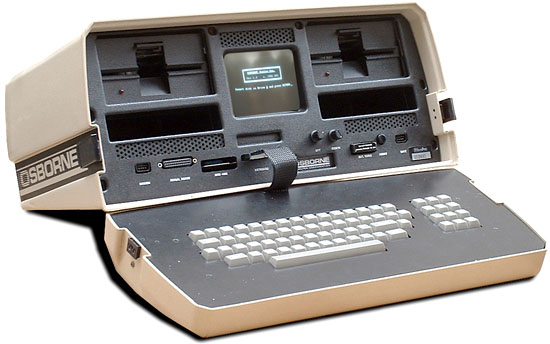
My first computer, we’re talking 1983, was an Osborne 1. It was billed as a portable, in the sense that it was designed to take a beating, and you could carry it around—well, not far, it was the size of a sewing machine and weighed twenty-five pounds. It had two drives for floppy discs and a monochrome screen that was smaller than a postcard. No battery and no fan. The design had a no-nonsense military feel, like an Army jeep. On top of that the $1,795 price included bundled software: CP/M, WordStar, and SuperCalc. But what I liked most about it was the full-size keyboard, which doubled as a lid: it had contoured keys that had a tactile feel and an audible click, as well as a proper numeric keypad. The design was obviously patterned on an IBM Selectric typewriter, which was also the model for the IBM PC, that appeared the same year as the Osborne (1981). I’ve never had a keyboard that I enjoyed as much, except for the IBM Thinkpad G40 that I owned two decades later. These days I write on a MacBook Air. It has all sorts of advantages that Adam Osborne never dreamed of, it’s powerful, lightweight, can function without a plug, and has a large sparkling color screen. But, oh those insipid chiclet keys!
You may be happy to know that some companies still make the kinds of keyboards that click and clack and bring much more joy than the chiclet keys so common laptops these days. For example, here’s one in Colorado: https://system76.com/keyboards/