Roundhouses

I recently heard from owner-builder Marvin McConoughey of Corvalis, Oregon, who with his wife built their own house in the 1980s. I was impressed by their ambition (the house is about 2,500 sf), and by their dedication (it took six years). My wife and I spent three years building our own house—which I thought was seriously pushing the limits of both our sanity and our conjugal well-being.

Oh, and the McConoughey house is circular in plan! What is it about round houses that fascinates people? Inigo Jones designed several octagonal houses (although as far as we know he did not build any) and Jefferson built a famous octagonal house at Poplar Forest.

Read more

Castle is Home

P1000698

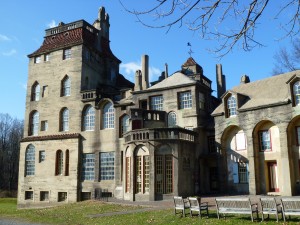
Fonthill Castle, in Doylestown, Pennsylvania, is rarely included among the great country houses of the Gilded Age. This extraordinary house is not designed by an architect, it does not follow one of the accepted styles of the period, and it is just, well, too weird. I can’t think of an American country house that looks like a fortified manor house, not even San Simeon—the closest is Sir Edwin Lutyens’s Castle Drogo in Devon. Fonthill was designed and built between 1908 and 1912 by Henry Chapman Mercer. Like many country-house builders,

Read more

LEED Lies


Why are so many LEED-certified buildings all-glass? It seemed to defy logic. After all, no matter how much you can reduce artificial lighting by using daylight, the insulation value of glass is negligible compared to solid insulated walls, and anyway there are many overcast days and dark winter afternoons. It is even  more puzzling when an all-glass building is shaded. First you wrap it in glass, and then you wrap the glass in something else. I always suspected that this was more about announcing “I am a green building” than about actually conserving energy. And now it’s official.

Read more

Boiling Water

Yanagi Tea Kettle 2

Every morning I boil water for making tea or coffee (I alternate). What starts my day is the most perfect kettle I have ever used. It is the work of Sori Yanagi (1915-2011), a Japanese product designer probably best remembered for his molded plywood Butterfly Stool. Yanagi studied architecture, but the kettle is decidedly not architectural—no purist Platonic forms, no postmodern irony, no gimmicky whistles. It is just a kettle: handle, spout, lid. Yet this perfectly balanced and shaped everyday object provides a feeling of well-being every time I use it—or even glance at it.

Read more

Like Father, Like Son

In an idle moment, I made a list of celebrated architectural dynasties. There are many examples in the past, when knowledge was passed down informally from father to son:

Bartolomeo Sanmicheli and his brother Giovanni and his son Micheli
Andrea Palladio and his son Silla
François Mansart and his grandnephew Jules Hardouin-Mansart
Jacques V. Gabriel and his son Ange-Jacques
William Adam and his sons Robert and John
James Wyatt and his sons Benjamin Dean and Philip
Sir George Gilbert Scott and his son George Gilbert Jr. and his son Sir Giles Gilbert
Samuel Pepys Cockerell and his son Charles Robert and his son Frederick Pepys
Sir Charles Barry and his son Sir John
Benjamin Henry Latrobe and his son Henry
Richard Upjohn and his son Richard M.

Read more

The DD Virus

Last week, after lunch at a bistro on Rittenhouse Square, I dropped in at the Comcast Center to look at the huge video screen—a digital mural—in the lobby. I had written about the screen two years ago, finding it captivating, and since the content regularly changes, I thought it would be fun to see it again. I watched for a while and found my attention wandering. The material seemed less creative, less witty and sophisticated, more predictable. Apart from an interminable clip of close-ups of baseball players in action, the segments seemed shorter, too. Then it dawned on me.

Read more

Modernism the Good

I’ve been reading David Watkin’s Morality and Architecture and I’m struck by the parallel that he draws between modernism and totalitarianism. Now, the conventional story, told and re-told by advocates of the International Style, was that modernist architecture was a moral force, not only opposed to (bad) nineteenth-century Beaux Arts architecture, but also to Nazism and Fascism. This claim was lent credence by the fact that so many leading modernists—Walter Gropius, Mies van der Rohe, Eric Mendelsohn, Marcel Breuer—had fled Nazi Germany. That Le Corbusier happily offered his services to the rightist Vichy regime in France,

Read more