
PHILLY PHLASH
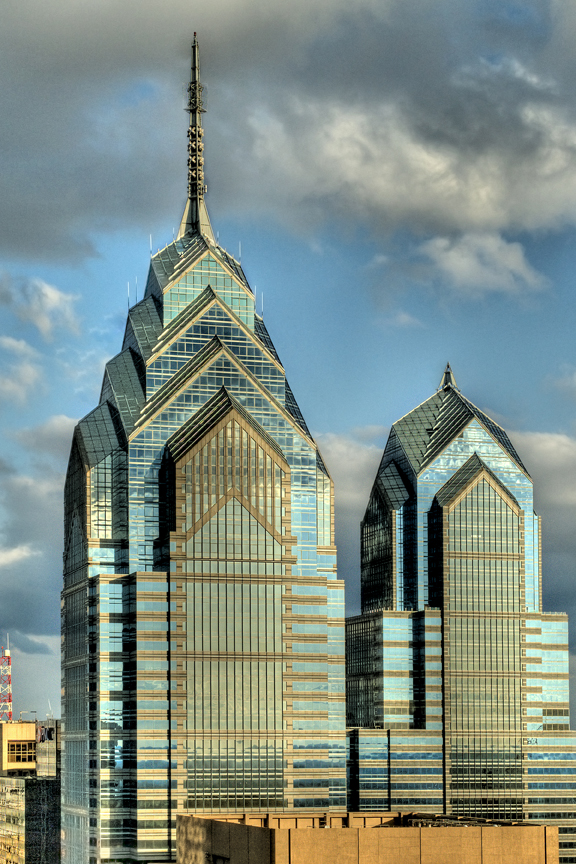
Helmut Jahn (1940-2021) died three days ago in an unfortunate bicycle accident. I don’t know if the world is a better place thanks to his flashy, in-your-face architecture, but his Liberty Place project, once the tallest in Philadelphia, does not make the city a better place. Ostensibly a take-off of the Chrysler Building, the pair of skyscrapers has always struck me as an uncomfortable presence on the skyline. First off all, Philadelphia has always had its own distinctive tall buildings, beginning with John McArthur, Jr.’s city hall tower (1894), Howe & Lescaze’s PSFS Building (1932), and Ritter & Shay’s U. S. Customs House (1934), so an ersatz New York tower seems out of place. Unlike Van Alen’s Art Deco original, Jahn’s building is modernist, and it suffers a problem common to most modernist work, that is, its big formal moves are unsupported by appropriate detail. There are no equivalents to the Chrysler’s hood-ornament eagle heads, the hubcap decorations, and the sunburst spire. The result is like a preliminary sketch–or a rough plasticine model. Moreover, to make matters worse, there are two towers (built in 1987 and 1990), which undercuts the effect. It is possible to make beautiful twin towers,
THE FOG OF LIFE
A recent conversation on GoodFellows, a podcast from the Hoover Institution, concerned Niall Ferguson’s recent book Doom, and included a comparison between military and civilian planning. This brought to mind what I have always thought was a weakness of the discipline of city planning. Good military planning, as I understand it, is based on preparing for “what if,” that is, developing different scenarios. What if this happens, or that happens? City planning is different, more like advocacy, that is, what should happen. This advocacy is based on certainties: open space is good, density is good—or bad, depending. The problem is that what planners think should happen—separation of pedestrians and cars, superblocks, megastructures—often runs into trouble when it hits the fog of life. Louis Kahn posited a city of mammoth parking structures, whereas Uber reduces the need for car ownership; Paul Rudolph imagined megastructures, whereas cities grow in unexpected directions—small increments help. Years ago, Jane Jacobs pointed out that the city was much too complicated to succumb to simple nostrums; better by far to learn from what was actually happening on the ground.
FEELING GOOD
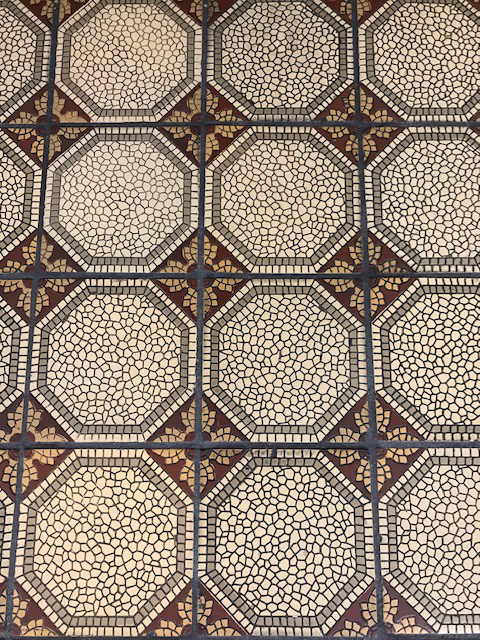
Walking down a corridor of Pennsylvania Hospital in Philadelphia I came across a decorative mosaic panel hanging on the wall. An accompanying label explains that it is a portion of the lobby floor of the Elm Building, which was demolished in 1981 to make room for the building in which I’m standing. The Elm Building was built by the hospital in 1901, a photograph on the hospital website shows an attractive one-story brick and limestone building with a pedimented temple front. Clearly a building of some consequence, it housed administration offices and an assembly room. The unidentified architect took trouble with the lobby floor, and imported the tiles from Germany, the work of Sinziger Mosaikplattenfabrik, located in northern Rhineland-Palatinate. The mosaic pattern replicates ancient Roman tile work. Nice stuff. Increasingly, I am coming to the Hemingwayesque conclusion that a “good building” is simply one that makes you feel good. This piece of saved floor does. The building that replaced it—not so much.

THE RIGHT STUFF
The Associated Press reports that President Emanuelle Macron has approved a plan to rebuild the roof and spire of Notre-Dame cathedral exactly as it was before last year’s fire. Hurrah! That means an oaken structure supporting a lead roof and a spire according to the nineteenth-century design of Eugène Viollet-le-Duc. A thousand three-foot diameter oaks are being felled to provide the timber, which must be allowed to season for at least eighteen months. According to the cathedral’s rector, Patrick Chauvet, the entire reconstruction is expected to take ten to fifteen years.

ROLL OVER BEETHOVEN
A musician friend sent me a recent article in the Telegraph reporting that “Musical notation has been branded ‘colonialist’ by Oxford professors hoping to reform their courses to focus less on white European culture . . . Academics are deconstructing the university’s music offering after facing pressure to ‘decolonise’ the curriculum following the Black Lives Matter protests.” According to the British newspaper, music professors said the classical repertoire taught at Oxford, which spans works by Mozart and Beethoven, focuses too much on ‘white European music from the slave period.’” Actually, Habsburg Austria-Hungary, where the pair lived and worked, was not a colonial power hence hardly involved in the slave trade, but you get the idea. So it goes in music teaching in a venerable university. Can architecture be far behind? The field seems ripe for revision, after all, Western architecture is—or was, until very recently—rooted in ancient Rome and Greece, both slave-owning societies. Out, damned column!

THE TROPICAL SHIRT
In a colloquium that took place during the 2016 Driehaus Prize ceremonies in Chicago, Andrés Duany made an interesting observation. He pointed out that Florida Panhandle resort towns such as Seaside, Rosemary Beach, and Alys Beach—all planned by his firm DPZ—were actually urban experimental testbeds with potentially long-term effects. “Americans are willing in the circumscription of a resort experience to try anything,” he said. He speculated that the people who holidayed in these walkable, dense, traditionally designed resort towns—so different from their everyday suburban communities—were affected, that is changed, by the experience. Now, I’m a great admirer of the Seaside prototype, which introduced a new model to holiday real estate: the resort as an actual village. Although the idea had earlier surfaced in Europe—Portmeirion in Wales and Port Grimaud in France—it was new to the U.S. But an urban testbed? I remember an incident, long ago, when my wife and I spent a holiday week in Martinique. We were in a good mood and while there Shirley bought a floral dress and I a tropical shirt. After we returned home to Canada we unpacked. We stared at the colorful clothes. What had we been thinking? They had looked so attractive in the French Antilles,