
CRYSTAL CITY
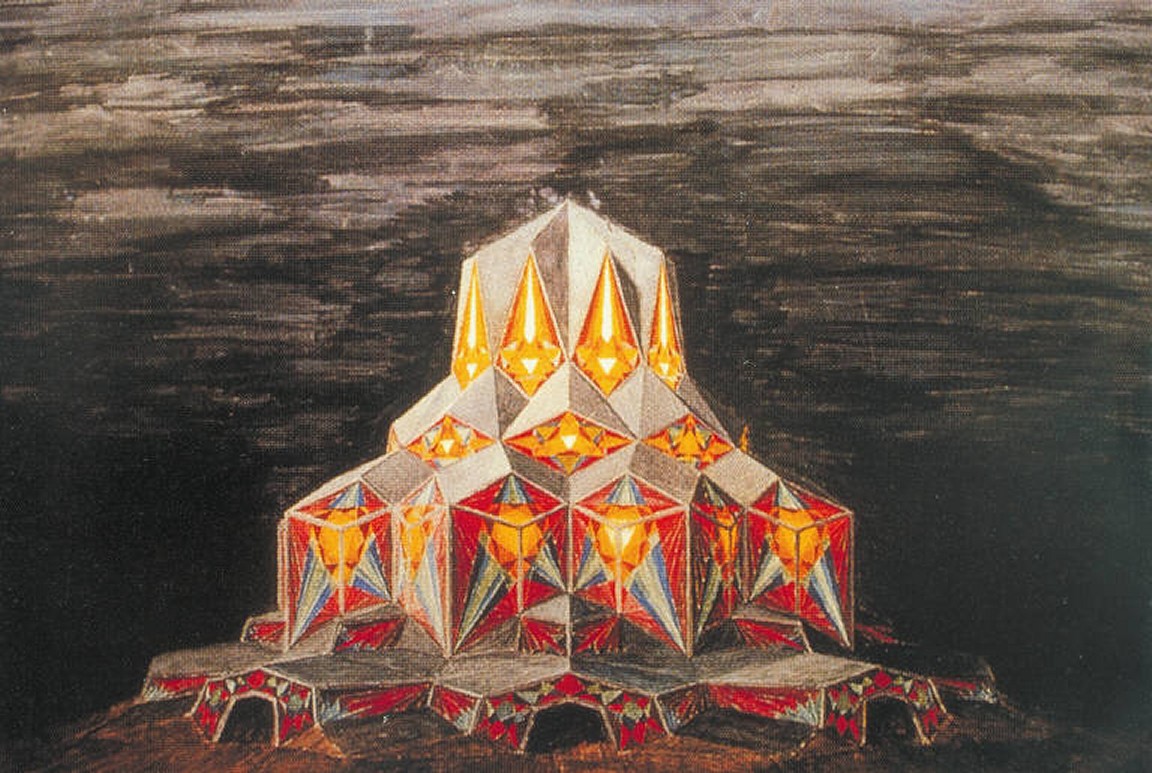
Paul Scheerbart (1863-1915) was a German writer of the turn of the nineteenth century; today we would call him a sci-fi author. In 1914 he wrote a novel with the unwieldily title The Grey Cloth and Ten Percent of White. The protagonist is an architect, more specifically a “glass architect,” and Scheerbart dedicated the book to Bruno Taut, a Berlin architect who promoted the idea of revolutionary all-glass buildings. Glasarchitektur (the title of another Scheerbart book) was an avant-garde obsession; Taut imagined “glowing crystal houses and floating, ever-changing glass ornaments.” When I look out my window I can see his crystal city come to life. It is certainly glowing, especially on a sunny day. Ever-changing? Well sort of. What is missing is the color and jewel-like qualities of Taut’s rather beautiful sketches. And the mute glass boxes undermine traditional architectural qualities such as mass and shadow, structure and weight, but I suppose that was the whole point of glasarchitektur.
Image: “The City Crown,” Bruno Taut, 1919.
HOUSE MEMORY
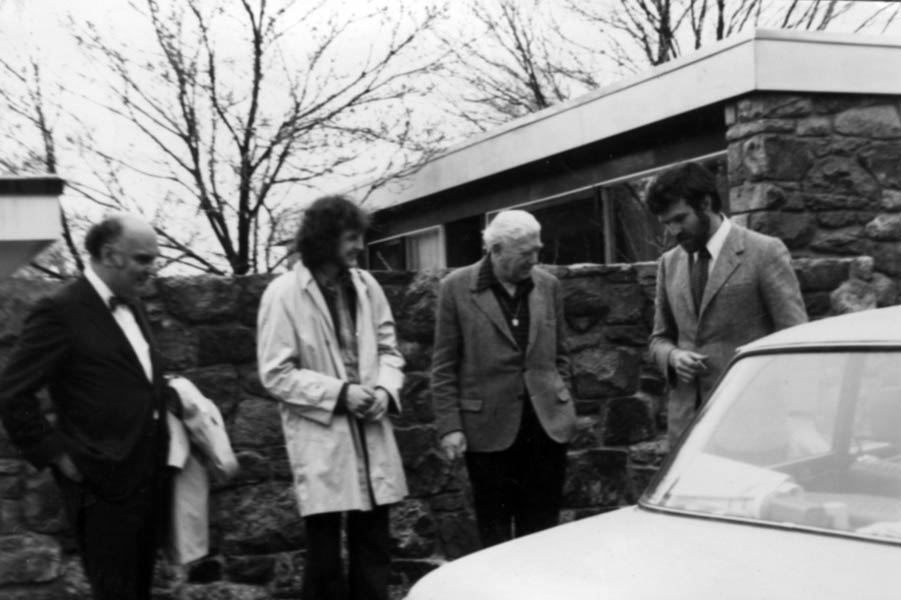
I met Marcel Breuer in October 1973 at his home in New Canaan, Connecticut. He designed the house, known as Breuer House II, in 1951, a low-slung affair with rough fieldstone walls, a slate floor, and an unpainted wood ceiling. Plate-glass windows looked out on a Calder stabile on the lawn, and nearby woods. We ate lunch sitting on Cesca chairs at a table that consisted of a thick granite slab. Breuer himself, 71, was courtly and engaging. Philip Johnson once called him a “peasant mannerist,” and there was something appealingly simple in his demeanor, as in the house itself. I admire Breuer’s houses, but that visit apart I have never actually seen one—I know them only from black-and-white photographs in books. So, when James S. Russell writes in the New York Times on the occasion of the demolition of Breuer’s Geller House, “Regrettably, the lessons such houses teach are lost as they grow fewer all the time,” I must disagree. The demolition of a public building—or any building in public view—can be like the loss of an old friend, but when a private house in rural surroundings is torn down, it is more like the proverbial tree falling unheard in the forest.

NOT THE POST OFFICE
One of the stated goals of the American Institute of Architects Strategic Plan 2021-2025 is “To ensure equity in the profession.” Equity may apply to pay, work opportunities, awards, or even, I suppose, to the makeup of the profession, that is, it should reflect the population as a whole. But the architectural profession is not the post office. It depends on the availability and preferences of clients, it depends on the swings of the economy, and success relies on individual drive and talent. Architecture is a zero-sum game, of course: there are a limited number of building commissions at any one time and if one architect gets the job, another doesn’t. Some of the most prominent commissions—the ones that build a reputation—are the result of architectural competitions. In these blind auditions, only the most talented have a chance to shine. And talent is not evenly distributed; “cream rises” as Stewart Brand memorably wrote in the Whole Earth Catalog. Hard to put your thumb on that scale. Finally, opening up architecture implies increasing the size of the profession. But there are already too many architects! When I was a student in Canada in the 1960s,
LET’S PRETEND
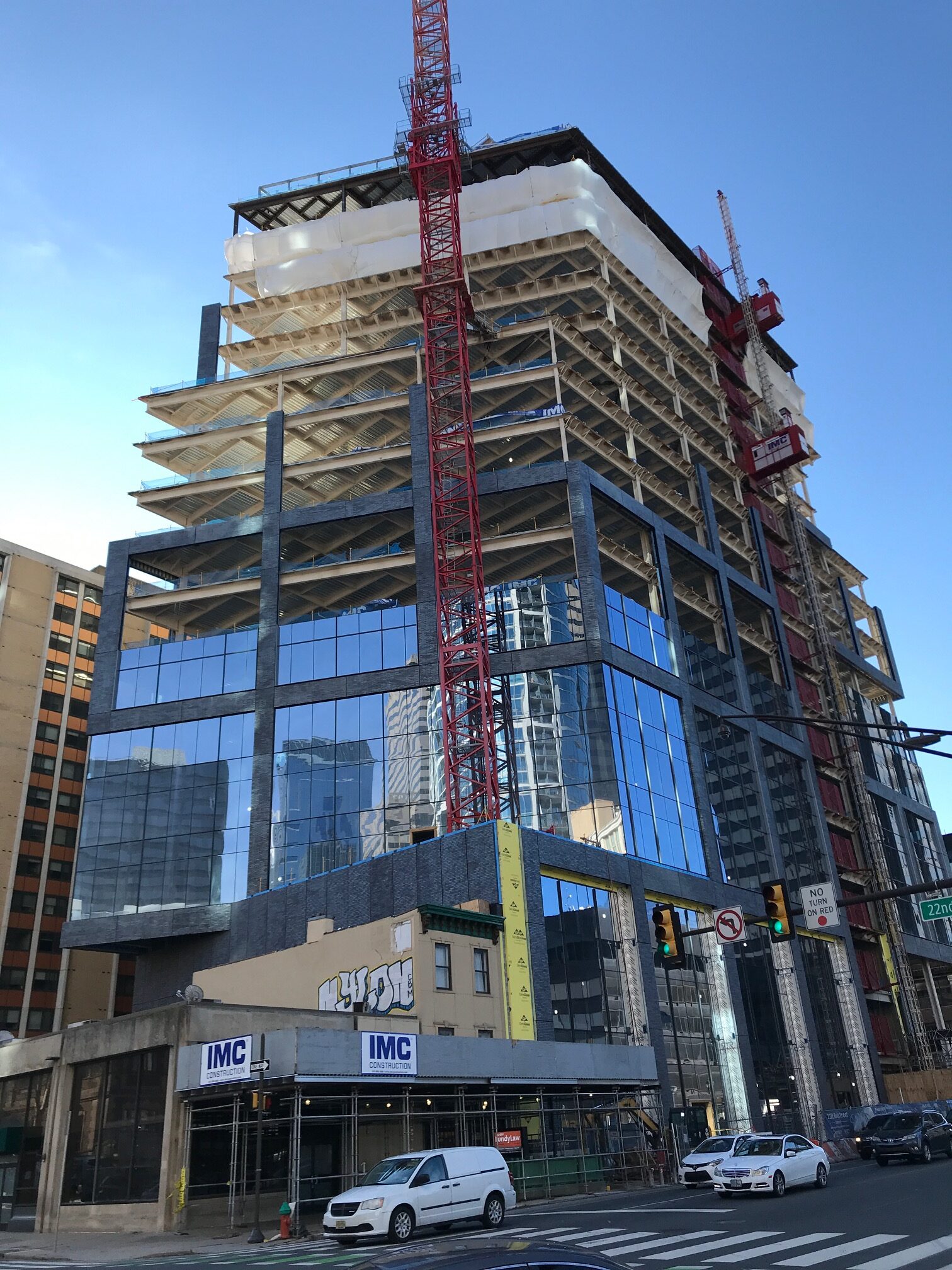
I’ve been watching a building going up a block from where I live in Philadelphia. 222 Market Street is a nineteen-story office block. The structure is steel, and except for a couple of odd slanted columns at one end, it is the sort of regular frame of I-beams that engineers have been designing for well over a hundred years; the first steel framed building in the U.S., was Burnham & Root’s ten-story Rand McNally Building in Chicago, erected in 1890. When the Market Street steel was topped off the structure reminded me of the high-rises that Mies van der Rohe put up in Chicago in the 1950s. Mies followed the age-old practice—going back to the ancient Greeks—of expressing the structure in the architecture; in his case in a very bare-bones fashion. That isn’t good enough for the architects of 222 Market (the global firm Gensler), whose approach I can only characterize as Let’s Pretend. The skin of the building, a combination of glass and flimsy-looking prefab glazed brick panels, is designed to give the impression that the building is composed of three-story high stacked-up boxes. In other words, architecture has been replaced by packaging.

THE TROPIC OF GRIEF
Shortly after my wife died, a friend emailed me a quote from Julian Barnes’s Levels of Life, which deals in part with the death of his wife of twenty-nine years. “This is what those who haven’t crossed the tropic of grief often fail to understand,” Barnes wrote, “the fact that someone has died may mean that they are not alive, but doesn’t mean that they do not exist.” It struck me as an intellectual conceit rather than a real insight. But I ordered the book from Abebooks. It was well written, as I had expected, and it was full of aperçus such as: “There are two essential types of loneliness: that of not having found someone to love, and that of having been deprived of the one you did love. The first is worse.” But I was still unconvinced that someone who had died could nevertheless exist. No longer. For me, Shirley does exist, not the memory of her, but her actual presence in our home—and in my consciousness. “I talk to her constantly,” was another Barnes comment that struck me as farfetched when I first read it. Now, months later,

FAME
I’ve just finished reading Roxanne Williamson’s American Architects and the Mechanics of Fame (1991). Despite some interesting historical research into the professional connections between architects and their mentors/employers, it is not a very satisfying book. The first question to ask about fame is “Who is judging?” The public, the architectural profession, the critics, architectural historians? Williamson considered only the last group. She compiled an “Index of Fame” by consulting twenty histories of architecture and four encyclopedias, and counting the number of times individual architects were listed. Since most recent historians (Giedion, Hitchcock, Banham, Pevsner, Fitch, and Scully) were interested in the history of modernism, this naturally skewed the results. An architect such as Rudolph Schindler, who designed a handful of interesting private houses was more “famous” than Paul Philippe Cret, who built major civic buildings such as the Federal Reserve, the Detroit Institute of Art, the Walter Reed Hospital, and much of the campus of the University of Texas in Austin. The second problem is that she treats fame as an absolute quality. But, as the old saying goes, “All glory is fleeting.” Sixty years ago, when I was a student, the architects we admired were Aldo Van Eyck,