Day One

I live in a neighborhood with many old houses. There are plenty of late nineteenth-century examples, but the ones I like best are from 1900-1930. The acknowledged masterpiece of this period is George Howe’s High Hollow, but there are plenty of runners-up, the work of accomplished Philadelphia residential architects such as Wilson Eyre, Frank Miles Day, Robert Rodes McGoodwin, H. Louis Duhring, and Edmund Gilchrist. These old houses seem to improve with age—the slate roofs get a bit mossy, the stonework acquires a patina, and the heavy hardware gets burnished with use. Their architects worked in more or less revival styles,

Read more

No Hoopla

Much has been written about the recently completed FDR Memorial in New York, designed by Louis Kahn. It was the great architect’s last project, and he had just completed it when he died in 1974, almost four decades ago. Kahn’s design reminds us how much has changed in forty years. First, the commission was not the result of a competition, no hoopla, no wowing the jury, no rush. Instead Kahn was given the time to ponder and reflect—which is how he worked, anyway. Second, although the site covers about three and a half acres on the tip of Roosevelt Island,

Read more

Urban Topos

There are many ways to measure cities: population, unemployment, crime rates, pollution, literacy rates, and so on. Aesthetics is harder to quantify, and so it is easier to ignore, yet beauty is also an important urban variable. Beauty in the manmade environment takes the form of streets, squares, and buildings, so it is tempting for cities to seek improvements in the urban equivalent of facelifts and makeovers: new boulevards, parks, civic monuments. But there is a type of urban beauty that is harder to improve: the natural setting. Cities on islands (New York, Stockholm) have a sort of self-contained magic.

Read more

Leaky Jim

In a history of postmodernism (history written on the fly since the book was published in 1984) Heinrich Klotz wrote: “James Stirling has received only one commission in his own country since he made his change to postmodernism, yet what stands in the way of postmodernism in Great Britain is not so much a lack of commissions as a continuing faith in modernism.” As evidence, Klotz cited the successes of Norman Foster, Ove Arup, and Richard Rogers. The persistence of modernism in Britain in the eighties was undoubted, but Stirling’s lack of commissions was due to something else.

Read more

An Age of Anxiety

pbs_newshour_coontz_2011

Every evening I watch the evening news. News may not be exactly the right word. The reports are a combination of speculation about what is about to happen—a presidential speech, a new pope, the Oscars—and spokespeople touting one point of view or another on the issue of the day. Which today is sequestration, or rather “what Washington refers to a sequestration,” as the media insists on calling it, despite the fact that by now it is a term surely familiar to all. But perhaps the most common “news” story is the revelation of a new topic of concern: a previously ignored disease,

Read more

Secret History

If I were compiling a secret history of architecture—those unpedigreed works of genius that stand outside the mainstream—I would include Gaudí, of course, but also many lesser figures: Henry Chapman Mercer, the builder of several amazing concrete structures in Doylestown, Pennsylvania; Paul Chalfin, the creative force behind that ebullient Baroque pile, Vizcaya, in Miami; and Simon Rodia, creator of Watts Towers in LA. I would also have to add my friend, George Holt in Charleston, whose Byzantine concoctions have no contemporary analog. There would also be a number of women in this company: Theodate Pope whose Avon Old Farms School anticipate Hobbits;

Read more

Bath Houses

Royal.crescent.aerial.bath.arp

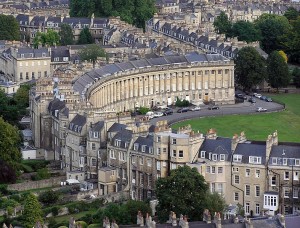
Ever since I first saw it years ago, I’ve admired the Royal Crescent in Bath. Designed and built by John Wood the Younger in the eighteenth century, it is an early example of real estate development informed by smart architectural design. What is remarkable about this housing terrace is that behind the great Palladian façade, which consists of a giant order of Ionic columns atop a rusticated base, are thirty individual houses. It worked like this. Wood and his partner bought the greenfield (literally, it was an undeveloped field) site from the Garrard family, and subdivided it into 30 lots.

Read more

Mike’s Place

6639BloombergPlaceNorth_pic1

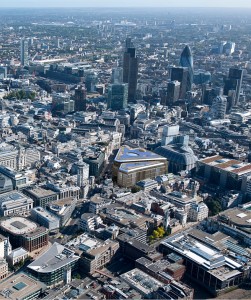
Bloomberg Place is a commercial development under construction in central London. The two wedged-shaped office buildings, linked by sky bridges, are designed by Foster + Partners, which is also responsible for the lumpy building next door. What is interesting about Bloomberg Place is its height: ten stories, since this part of the city has a fifty-meter height limit. Washingtonians, currently engaged in a debate over raising the long-time height limit in that city should take note.

Read more