MoMA Mia

fol art

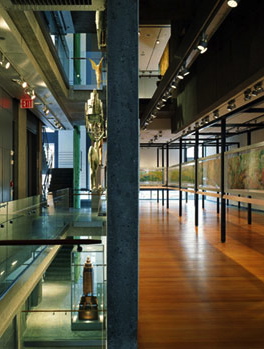
I find it hard to believe the stated rationale for the demolition of what had been the home of the American  Folk Art Museum on 53rd Street—that its blank façade does not accord with MoMA’s glassy image. I’m not one to defend the inhospitable face that Williams & Tsien’s design turns to the street, but MoMA itself is hardly the most considerate neighbor, as I wrote in Slate shortly after Yoshio Taniguchi’s makeover opened. The truth is that the building whose announced demolition has caused such a furor, at least among architects and architecture critics,

Read more

Detached Retina

My friend George Holt and I were talking about how architectural education ill-prepares young architects for the world of practice. “Is this sort of detachment from the realities of the profession a deliberate agenda that’s perhaps for some other useful purpose that escapes me?” George asked me. I don’t think so. In part, the detachment is a legacy of the art school tradition that shaped architecture schools since the Ecole des Beaux-Arts and the Bauhaus. Of course, artists have always worked on commission, too, just like architects, but the unspoken ideal is the self-sufficient artist—Van Gogh, Gauguin, Matisse—whose inspiration was entirely personal.

Read more

Soleri

soleri

Paolo Soleri died yesterday at 93. I first heard of him when I was a college student. A classmate, Ray Catchpole, had spent the summer at Soleri’s desert compound in Arizona (he had several sand-cast bronze wind bells in his room), and he encouraged me to go if I had the chance. That year—1964—I was editor-in-chief of Asterisk, a student magazine, and it must have been through Ray that we got Soleri to send us an article: “Computer, Craft, and Art Architecture.” I admired Soleri’s work, several bridge designs, as well as a desert house with a retractable dome roof.

Read more

Collegiality

During his acceptance speech at the Driehaus Prize ceremony in Chicago a couple of weeks ago, laureate Thomas Beeby made an interesting point: architecture is turning into an uncollegial profession. Of course, architecture has always been highly competitive. Building is a zero-sum game, that is, only a limited number of commissions are available at any one time, so if one architect gets to build, another doesn’t. Established, experienced practitioners have always had the inside track and access to the best jobs and the best clients; novices get whatever’s left over. But Beeby was making a slightly different point. Despite the competitive nature of the profession,

Read more

Big John

P1000793

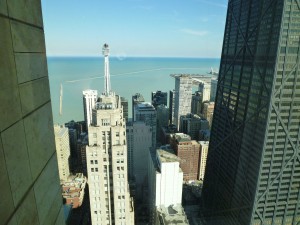
I was in Chicago recently for the Driehaus Prize ceremony, and I was staying in a hotel across North Michigan Avenue from the John Hancock Center, in fact my fortieth-floor room looked directly at the building. Built in 1969, and designed by Bruce Graham and Fazlur Khan of Skidmore Owings & Merrill, this has always been one of my favorite Chicago skyscrapers. The characteristic tapered silhouette is much more successful than the Sears Tower (another Graham-Khan collaboration), and the crisscrossing bracing remains an evocative expression of its structure. I could see Mies’s 860 Lake Shore Drive from my hotel room,

Read more

The White City

During the last decade or so, Washington, D.C. has undergone a little-noticed but remarkable transformation: a city of stone is becoming a city of glass. Ever since the McMillan Plan, and even before, important civic buildings in the capital were built out of marble, limestone, or concrete. There were a few early brick outliers such as the Smithsonian Castle, and the Pensions building, but generally architects followed this custom. This was not a question of style, since modernist as well as postmodernist architects—Breuer, Bunshaft, Pei, Stone, Obata, Erickson, Graves, Freed—all followed the age-old practice, which had been virtually codified by Burnham,

Read more

Driehausville

laubin

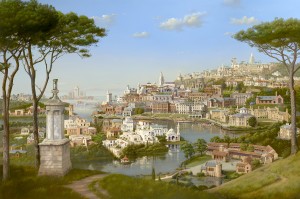
Carl Laubin has painted a beautiful capriccio to commemorate the tenth anniversary of the Richard H. Driehaus Prize. He portrays an imaginary town made up of the works of the first ten Driehaus laureates, among whom are Léon Krier, Quinlan Terry, and Demetri Porphyrios, as well as Allan Greenberg, Jaquelin T. Robertson, and Michael Graves. In the foreground is the Choragic Monument of Lysicrates, a bronze miniature of which is presented to each laureate. It’s fun to try and identify the individual works in this large (5½ by over 8 feet long) painting.

Read more

Hitler’s Architect

speer

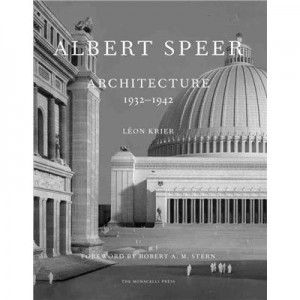
In 1985 Léon Krier published Albert Speer: Architecture 1932-1942, a monograph on the work of Hitler’s architect. The book, assembled with Speer’s assistance, was received with almost universal opprobrium, Krier was vilified, Speer’s version of classicism was ridiculed, the whole thing written off a sick joke. Now, almost thirty years later, Monacelli has produced a facsimile edition of the book, together with new material by Krier and a foreword by Robert A. M. Stern. Perhaps this time the reception will be different, but I doubt it. Speer’s brand of stripped classicism is so much associated with Nazism,

Read more