
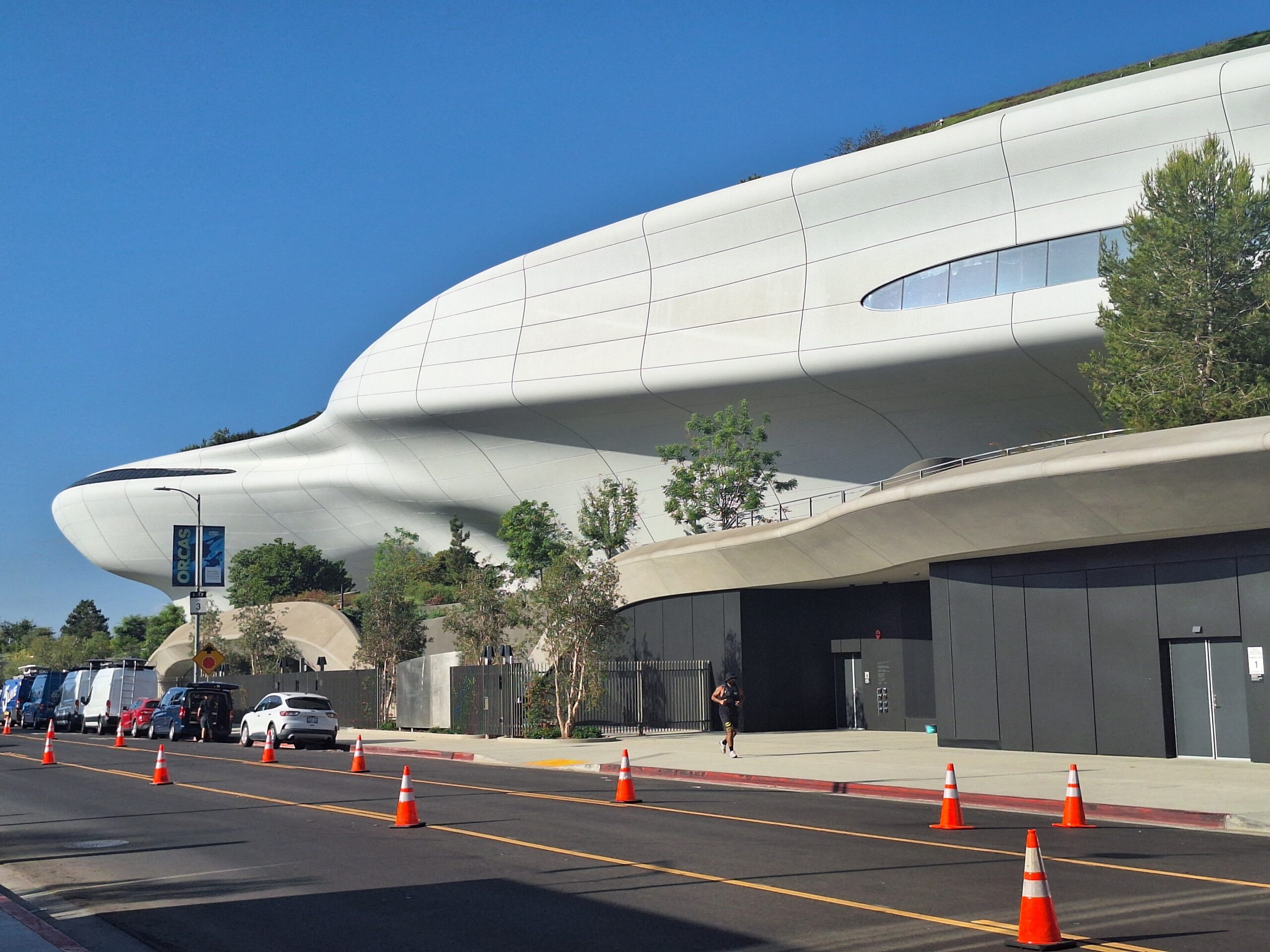
I’ve not visited the new Lucas Museum of Narrative Art in Los Angeles, but I have read that its skin is made of fiberglass-reinforced polymer. Beneath the biomorphic forms are the hidden bones of structural steel. Sort of like the human body, you might say. Or perhaps like an automobile, whose structure is concealed beneath a sculpted body of thin metal—or fiberglass, in the case of a Corvette.
There is a long history of architects trying to make buildings that look as if they had grown rather than been assembled. Frederick Kiesler’s Endless House is the progenitor of such biomorphic buildings. It existed only as a plaster-of-Paris model, but had it been built, it would probably have been made of ferrocement: cement sprayed over a mesh armature. Le Corbusier used a similar technique at Ronchamp, where the curving walls and roof are not simply a surface applied to a building; they are the building. Eero Saarinen’s TWA Terminal is another example. Its swooping forms are thin-shell reinforced concrete. The shell is also the structure; the swooping forms have to hold themselves up.
The Lucas Museum is different. Its carapace does not support anything. If some of the Lucas collection can be described, as the Wall Street Journal‘s art critic has suggested, as posters aspiring to the status of art, perhaps this building might be described as industrial design aspiring to the status of architecture. A Corvette is a beautiful object. But it is worth remembering that a building is not a car, and architecture is not a body style.
Photo credit: Michael J. Lewis