
Describing the Königliches Schloss, the rebuilt imperial palace in Berlin, Michael J. Lewis wrote recently in The New Criterion: “It is not so much a recreation of the palace as a workmanlike scale model of the original, placed on the original site, and with something of the gift that Robert Venturi gave to historic preservation, which is a saving leaven of self-aware irony.” This is a useful insight: irony is a way for modernists to deal with the past without actually acknowledging its primacy. But was Venturi’s “leaven of self-aware irony” a gift or a poison pill? Venturi’s firm lost important commissions such as the Philadelphia concert hall precisely because clients did not appreciate ironic, or sometimes downright jokey, architectural asides. Most clients—Vanna Venturi aside—are loathe to see their money spent on something as insubstantial and potentially risible as irony. And irony gets stale over time; is that why so many VSB buildings have fared poorly, being insensitively enlarged, or demolished as in the recent case of the Abrams House (see above) in Pittsburgh? Absent idiosyncratic follies and amusement parks, architecture is more serious than that.
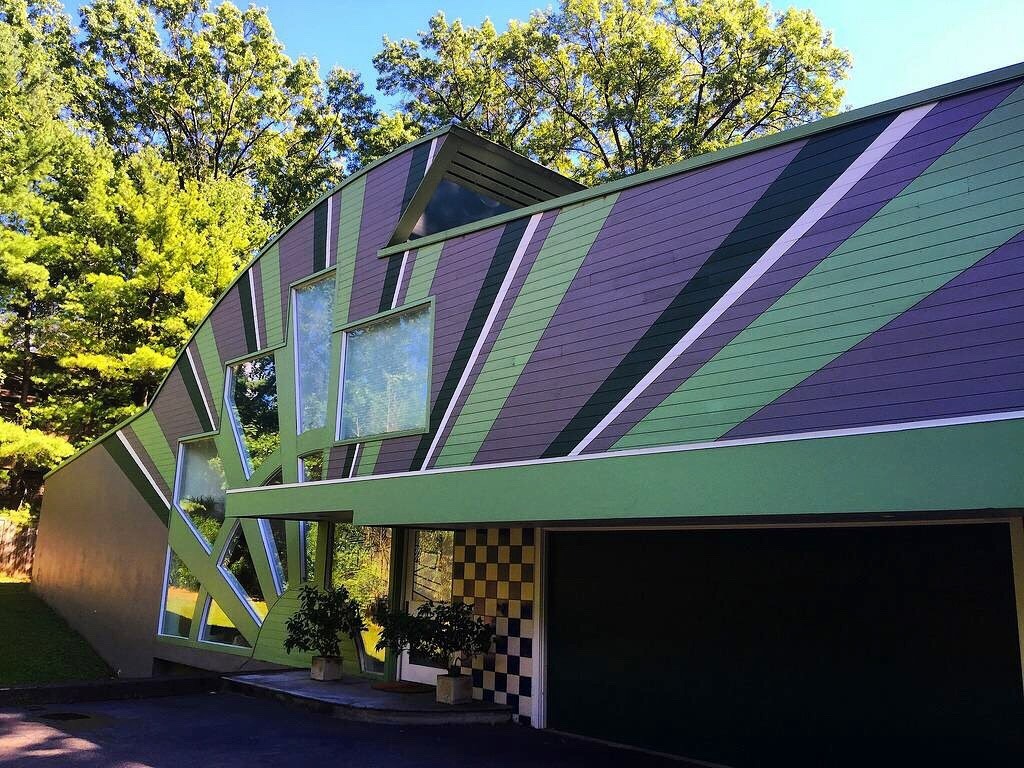
The Abrams house was a site specific design. Its form and theme grew out of the house’s relationship to an adjacent stone arch foot bridge that was itself a folly in the garden of an early 20th century Tudor mansion. The mansion’s grounds were subdivided in the late 1970’s and the Venturi designed Abrams house and the Richard Meier designed Giovanetti house next door were built on the resulting small lots.
New owners of the Meier house recently bought the Abrams house from the Abrams estate, with the intent to double the size of their rear lawn and to erase views of the Abrams roof from their sightlines.
Interestingly, the Meier designed house has been in an almost continual state of repair owing to its seeming lack of weather hardiness since it was completed in 1984. The Venturi designed house stood proud and solid for 40 years never needing more than routine maintenance. Which building was architecture…doesn’t an architect owe their clients firmness with the delight?
This Venturi design fell because the neighbor wanted their pristine sugar cube stack to sit alone like the modern sculpture it is on a wide lawn.